
LSS deploys large antenna
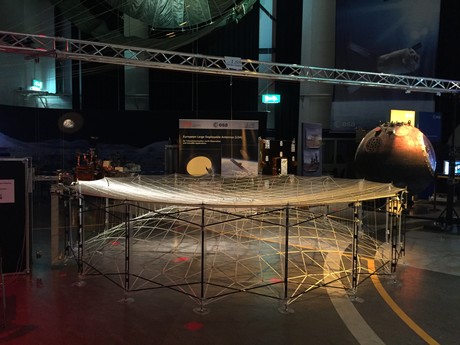
A test deployment has been undertaken for a 5 m diameter antenna, which is designed for orbital operations.
Previously, the European industry was unable to field reflectors that were larger than 4 m in diameter. However, large reflectors are increasingly required for telecommunications, science and Earth observation missions.
The reflector was developed as part of an effort addressing a full large deployable antenna system through ESA’s Basic Technology Research Programme (TRP) by a consortium led by HPS GmbH in Germany, with Germany’s Large Space Structures being responsible for the reflector and its deployment.
The deployment took about seven minutes to unfold automatically into its final configuration.
“This reflector has a ‘double pantograph’ design to form a deployable ring,” said ESA’s Alexander Ihle.
“Once deployed, it tensions two opposing but connected parabolic nets, one on the top and one on the bottom.”
The challenge is to develop a reflector that can easily be stowed within the limited space available inside a launcher fairing and then opened to its full size while remaining sufficiently stable and accurate afterwards to meet strict performance requirements, including the use of high-frequency radio signals.
The top netting supports and maintains a very finely knitted metallic mesh in a predefined shape.
“This mesh is what will eventually reflect the radio signal — doing the real work of the reflector,” said Leri Datashvili, Large Space Structures GmbH.
The design is also scalable, both in terms of the reflector diameter and moving up into higher frequencies.
Another 5 m reflector, also supported through TRP but based on carbon fibre reinforced silicone surface, was tested in ESA’s Large Space Simulator thermal–vacuum chamber earlier this year.
Pivotel launches satellite connectivity solution at Comms Connect
Visitors to Comms Connect will be able to see the Pivotel OneTouch SL-Mini and discuss how...
Digital radio system coming to SEQ rail network
A new digital radio system will be deployed as part of Stage 1 of The Wave — a...
SA bolsters emergency radio network ahead of boating season
A $1m upgrade of SA's VHF radio repeater network is now complete, improving critical distress...