
Fraunhofer IIS tests high bandwidths for non-terrestrial networks
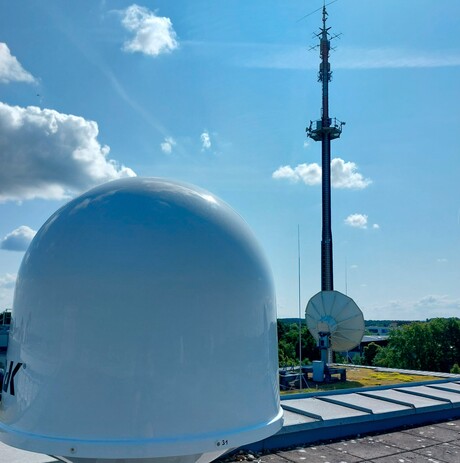
Geostationary satellites transmit vast amounts of data, cover large areas on the ground, and provide reliable availability. They primarily support applications with low latency sensitivity, such as streaming or software updates. In future 3D networks, they can therefore form a stable, high-capacity overlay for the more dynamic, lower-altitude components of NTNs. In addition, they can step in during outages or capacity bottlenecks to ensure seamless global connectivity.
In a recent communication experiment with the geostationary Heinrich Hertz satellite, Fraunhofer IIS demonstrated a broadband 5G NTN connection. The end-to-end transmission in frequency band n512 (Ka-band) was based on 3GPP Release 18 of the 5G standard. The researchers used bandwidths ranging from 50 to 100 MHz and achieved data rates of up to 137 Mbps.
The use of the Ka-band is already well established in conventional satellite communications, but the satellite transmission of 5G signals at high gigahertz frequencies remains largely untested. Corresponding gateways with integrated 5G base stations and NTN receiver terminals are currently not available on the market.
To enable broadband 5G operation in the Ka-band, researchers at Fraunhofer IIS therefore developed specially adapted transmission and reception equipment, enabling transmissions with bandwidths of up to 100 MHz during the tests.
“With the successful demonstration of an end-to-end 5G transmission in the Ka-band, we have shown how broadband 5G connections via satellite can be realised,” said Rainer Wansch, head of the RF and SatCom Systems Department at Fraunhofer IIS. “This provides the basis for satellites to work seamlessly with existing 5G infrastructure in future 3D networks.”
Another key criterion for seamless connectivity is precise handovers, as modern GEO satellites use a large number of individual transmission beams to send signals to Earth. When a user leaves the coverage area of one beam and moves into the footprint of an adjacent beam, a stable handover is required. This is particularly important for mobile applications such as in-flight connectivity or connectivity on board ships. Seamless handovers ensure that passengers and crew remain online without interruption.
Fraunhofer IIS was able to successfully demonstrate such a handover in the FR2 spectrum for the first time as part of the communication experiment. The handover took place between the north and south beam of the Heinrich Hertz satellite, which is being used as an experimental platform in space. To achieve this, the Fraunhofer IIS experts implemented handover capabilities in both the base station (gNodeB, gNB) and the 5G user equipment (UE) used in the tests. Both the gNB and UE are fully software-defined solutions. They are based on OpenAirInterface, an open-source implementation of the 5G protocol stack, that was specifically optimised for high channel bandwidths and inter-beam handovers.
The tests were conducted as part of the Heinrich Hertz mission, led by the German Space Agency at the German Aerospace Center (DLR), and funded by the German Federal Ministry for Research, Technology and Space.
Aviat WTM 4400 Quad all-outdoor radio
Aviat Networks has announced the WTM 4400, also known as the Quad, which supports four...
Pivotel OneTouch SL-Mini portable satellite connectivity solution
Pivotel's OneTouch SL-Mini is a rugged, portable satellite connectivity solution designed...
Inrico TM-7Plus smart PoC mobile radio
Inrico's TM-7Plus smart PoC mobile radio offers up to 60 V anti-overvoltage protection,...