Futureproofing RNZ's infrastructure
Radio New Zealand (RNZ) recently successfully replaced two aging AM broadcast masts with one new mast at the Henderson transmission site, securing Auckland’s emergency broadcasting capability for the next generation.
State-owned telecommunications company Kordia played a major role in the project with the design of the new mast, development of the works methodology and the rigging works onsite.
RNZ’s Henderson transmission site had long been the backbone of AM broadcasting for the wider Auckland region, carrying AM radio services from two aging masts: a 122-metre structure over 90 years old, and a 153-metre mast dating back more than 70 years.
The challenges were significant. The proximity of high voltage powerlines, critical underground services, transmitter building, roads and the Northwestern Motorway limited the methodologies that could be used for the works. The ground condition on the two sites required specialist crane access track and hardstand engineering, and trees on boundary areas created consenting complications that took months to resolve. Throughout the project, RNZ’s AM services, including its emergency broadcasting function, had to remain available with minimal disruption.
Kordia’s structural engineering and specialist rigging teams developed a comprehensive plan to decommission both masts and install a new 110-metre replacement, the height being determined by RNZ’s AM operating frequency requirements.
The design drew on proven methodology from a prior Kordia mast project at Porirua’s Titahi Bay, adapted for Henderson’s unique site constraints. The new mast was engineered with a minimum 50-year design life.
Constructed in 6 m sections for transport efficiency, the mast was assembled by Kordia riggers into four larger sections onsite before crane installation. Each section required temporary and permanent guy wire installation before the next could be lifted into place.
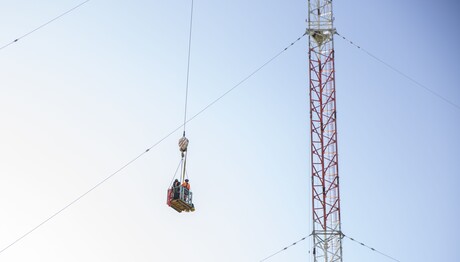
Removing the 153 m southern mast presented a distinct engineering challenge. With hook heights beyond crane reach for the upper portion, and space constraints preventing ground-level operations, the top 40 metres required helicopter removal. Sections were cut to weigh no more than 800 kg — well within safe lifting limits — and the helicopter navigated between guy wires to place each section within the restricted site area.
Service continuity was built into the project from the outset, with careful management of outage windows. Emergency broadcasting protocols were established to halt work and restore services immediately if critical announcements were required.
Mast preparation works commenced in January 2026, followed by civil works ahead of the mast works which commenced on 16 April. On 12 May, the first AM services on the new 110 m mast were brought into service.
RNZ’s Transmission Manager Steve White said the project pushed the boundaries of practical engineering, supporting eight AM radio services from a single mast, and was one of the most complex he has led during his time at RNZ. Internationally, it’s rare to run this many AM services from one mast, with most networks opting to build additional structures instead.
“Replacing infrastructure that has served Auckland for generations while maintaining uninterrupted emergency broadcasting capability was a significant undertaking,” he said. “The level of planning, technical expertise and collaboration between RNZ and Kordia was exceptional. The result is a modern, resilient transmission asset that will support our audiences and public service responsibilities for decades to come.”
The new mast also secures Auckland’s AM emergency broadcasting capability with infrastructure designed to last 50 years or more, directly supporting RNZ’s critical public service role.
Kordia says the project stands as a benchmark for complex broadcast infrastructure renewal in constrained urban environments, combining specialist structural engineering, precision rigging, helicopter operations, multi-stakeholder coordination and live-service continuity management into a single, seamlessly delivered outcome.
RNZ Chief Technology Officer Mark Bullen says the project represents an important investment in RNZ’s long-term resilience.
“This project is about much more than replacing aging infrastructure. It strengthens RNZ’s ability to deliver trusted information when New Zealanders need it most, particularly during emergencies,” he said. “The new Henderson mast provides a future-proof foundation for our AM broadcasting services and demonstrates what can be achieved through strong partnership, innovation and engineering excellence.”
Phone: 0011 64095517000
Spectrum Control High-Power SAW Filters
Spectrum Control's High-Power SAW Filter portfolio has been designed to address the demanding...
DuxTel data network technology solutions
DuxTel is a data network technology solutions specialist, supplying, engineering and supporting...
Hypha HyphaONE Mini S mobile connectivity platform
The unit combines Starlink Mini, 5G and Wi-Fi 6, turning a vehicle into a communications hub for...