VIAVI launches caesium-less primary reference time clock

VIAVI Solutions has launched a caesium-less primary reference time clock to safeguard at-risk critical power grids, transportation, aviation and public safety systems, 5G mobile networks and AI data centre infrastructure against the increased threat of GNSS timing disruptions. The company says its ePRTC360+ holdover solution is the only alternative to caesium clocks to meet ITU-T G.8272.1 standards.
The international ITU-T G.8272.1 standard stipulates that Enhanced Primary Reference Time Clock (ePRTC) holdover must have short-term drift of less than 30 ns when entering into holdover and a long-term drift of less than 100 ns over 14 days, all traceable to UTC. Previously achieved only by caesium atomic clocks, VIAVI’s ePRTC360+ now also meets this standard.
“The caesium-less ePRTC360+ exceeds leading-edge caesium-level holdover performance and does this for significantly lower price,” said Doug Russell, Senior Vice President and General Manager, Aerospace and Defense, VIAVI. “This enables deployment across the sync network, particularly at edge sites which were previously cost-prohibitive with caesium holdover clocks.”
The ePRTC360+ has been tested across a range of live-sky defence and commercial jamming/spoofing environments, and has been integrated into VIAVI’s SecurePNT 6200 product series. The technology can maintain 100 ns accuracy during GNSS-denied threats through the resilient altGNSS GEO-L service with no time limit. It also combines an augmented VIAVI SecureTime GEO anti-jamming antenna and an enhanced GNSS anti-spoofing antenna that also receive eGNSS GEO service with GPS/GNSS-NMA authentication for spoofing detection and mitigation.
Unlike conventional GNSS omni-directional signals, which can be drowned out by low-power interference, VIAVI’s GNSS-independent GEO-L service leverages encrypted and highly directional L-band signals transmitted from geostationary satellites. Coupled with the VIAVI SecureTime GEO antenna, the altGNSS GEO-L service provides enhanced anti-jamming protection and a resilient timing reference for the ePRTC360+’s internal rubidium holdover oscillator, and enables smooth multi-orbit source switchover, even when primary GNSS frequencies are jammed, spoofed or subject to sophisticated meaconing attacks.
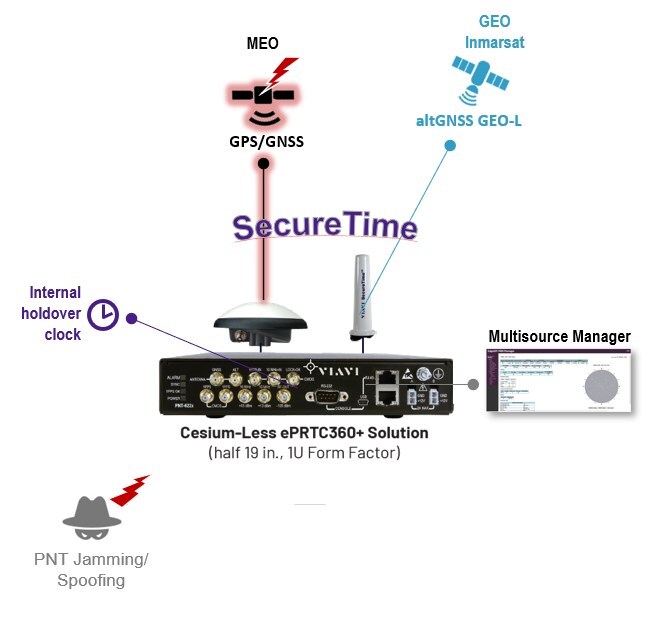
The affordability of ePRTC360+ clocks compared to caesium clocks enables operators to deploy them beyond the core and across the network. They also complement non-RF caesium clocks at the core. This boosts end-to-end sync network robustness and holdover reliability through meshed network PTP feeds as backup between the clocks, especially in case of local or regional jamming or spoofing threats.
In addition, the ePRTC360+ addresses constraints posed by the use of caesium clocks for holdover timing. These include sensitivity to shock, delicate and multi-stage startup procedures that take days to complete, the need for ECCN 3A001.i licenses for export, long GNSS learning period of up to 40 days, and strict shipping and storage protocols. In addition, caesium tubes need to be replaced approximately every seven years, and the dismantling and disposal of caesium clocks is classified as a hazard due to their material content.
Lite Coms tactical satellite terminals to support the ADF
US company Lite Coms has been selected to provide tactical SATCOM technology in support of the...
Pivotel launches satellite connectivity solution at Comms Connect
Visitors to Comms Connect will be able to see the Pivotel OneTouch SL-Mini and discuss how...
Digital radio system coming to SEQ rail network
A new digital radio system will be deployed as part of Stage 1 of The Wave — a...