How thousands of tiny dots could save first responders' lives
In an emergency, knowing exactly where a first responder is can mean the difference between life and death. When a firefighter in a burning building fails to check in, how does the commander know where to look for them?
Public safety agencies face daily challenges in finding first responders inside large buildings. Yet there are no reliable methods for tracking first responders in these types of environments.
To try to solve this problem the US National Institute of Standards and Technology (NIST) partnered with Indiana University’s RedLab. The goal of the First Responder Smart Tracking (FRST) Challenge was to create prototype devices that track first responders indoors. In the five years since the challenge launched, teams from across the world have developed dozens of novel solutions — some of which have been turned into commercial products.
NIST is working with teams to ensure that their solutions meet the needs of public safety agencies, such as encouraging participants to make products affordable enough for first responder budgets.
GPS and the challenge of indoor navigation
The widespread adoption of GPS has mostly solved the difficulty of navigating outdoors, but GPS is unreliable indoors. Tracking our location with GPS requires a device to sense signals from satellites surrounding the user’s location, but layers of building material can block or interfere with those signals.
This problem is even worse for high-rise buildings. They have more building material and are often built in dense urban environments. In these scenarios, it’s even more critical for an incident commander to know exactly where their personnel are located.
The FRST Challenge asks participants to create wearable devices that are:
- easy to wear and carry
- able to track a responder accurately through complex buildings and long paths
- capable of communicating back to the base station
- tough enough to survive a firefighting environment.
The challenge
Verifying the accuracy of these systems is a significant challenge. That’s why NIST used the dots facility, an indoor localisation test bed developed by Nader Moayeri on the NIST campus in Gaithersburg, Maryland, to test these systems.
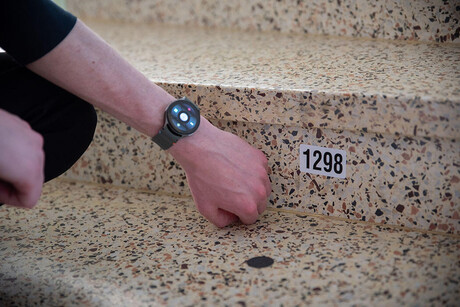
This system involves more than 2000 carefully documented points (marked with stickers) inside and outside NIST buildings. These points, or ‘the dots’, are spread throughout the campus — in hallways, stairwells, offices, laboratories, machine shops, underground tunnels, warehouses and many other spaces. The variety and size of locations available makes the NIST campus an ideal place to conduct these experiments.
In May 2025, NIST put the competitors’ systems through their paces. Teams attached their systems to participants who navigated a series of scavenger-hunt-like missions. They had to find hundreds of individual points. Each team used its system to estimate the position of each dot along its course. NIST scientists and engineers then analysed the data against the known position of each dot to rigorously judge the accuracy of each system.
Continuing the research to keeping first responders safe
If first responders are going to use this technology, there has to be confidence in it and it has to be shown that it’s been thoroughly tested.
Although the FRST Competition has officially wound down, NIST will continue to work with partners on developing indoor tracking innovations for first responders.
To that end, NIST recently built the Public Safety Immersive Test Center in Boulder, Colorado, to conduct research on first responder user experience and location-based service technologies. These researchers are also testing algorithms to track first responders in buildings.
Competitions such as this one encourage private sector innovations in public safety. Without them, companies wouldn’t have the financial incentive to invest in creating these types of products.
Comms Connect preview: connecting the NHS
Modern healthcare delivery depends on reliable and secure connectivity, yet many of the UK's...
Essential cathodic protection with web-based monitoring
Omniflex has been aiding local authorities in Queensland with the essential maintenance of...
How the right antenna can deliver critical insights into wastewater
Without consistent data collection and communications, utility networks risk undetected failures...