An introduction to interference hunting
By Paul Denisowski and Peter Busch, Rohde & Schwarz
Monday, 13 July, 2026
The rapid rise in the prevalence and importance of radio frequency communications has increased the significance of interference hunting.
Much of what we do today depends on having high-quality communications systems in place. Radio frequency interference, in which RF energy degrades the performance of an RF communications system, can have a significant impact on the end user’s quality of experience and, in some cases, have catastrophic results. As radio systems have evolved and become more complex, and as the number of interferers has steadily increased, the importance of interference hunting has grown significantly.
For over a hundred years, radio frequency (RF) signals have been used for the transmission of information over both short and long distances. However, the last few decades have seen a fundamental shift in the nature of how these communications take place, and the risk of interference has increased dramatically.
What is interference?
The term “radio frequency interference” refers to situations in which the presence of RF energy degrades the normal operation of a wireless communications system. There are no specific level or frequency criteria that must be met in order for something to be considered interference: signals that affect the service of an application may have no negative effect on other applications. Simply put, the definition of interference is a purely functional one: any radio frequency signal that has a negative impact on the ability to operate a wireless communications system can be considered interference.
Effects of interference
The effects can vary tremendously depending on the characteristics of both the interferer and the affected system. In fact, the very first step in interference hunting is to detect the presence of interference. In some cases, poor system performance may be due to design issues rather than interference.
Fortunately, there are certain common symptoms that can indicate the presence of interference. For example, in analog voice communications systems, interference often becomes immediately apparent to users in the form of noise, static, superimposed audio and unexplained breaks in squelch.
In digitally modulated communications systems, the presence of interference is often not immediately obvious. Poor voice quality is one indication of possible interference, although voice quality can depend on a variety of factors. A more reliable indicator of interference in digital networks is dropped calls or lost connections. Low data throughput or high retransmission rates are also good indications that some form of interference may be present. Owing to the adaptive nature of many modern communications systems, interference in digital networks can cause the system to revert to more robust transmission modes or lower-order modulation types; communications may still be possible, but with substantially degraded performance. Furthermore, the severity of these effects may not increase linearly with the level of interference.
What is interference hunting?
In some cases, it is possible to compensate for interference without actually shutting down the interferer. For example, the use of shielding or filters, changing antenna orientation, changing frequencies, etc, can limit the effects of the interfering signal on the affected device. However, in the vast majority of cases the only way to eliminate the interfering signal is to identify, locate and disable it. The process by which an interfering signal is identified and located is called interference hunting.
As mentioned above, the first step in interference hunting is recognising that there is interference. A related and equally important task is analysis of the behaviour, spectral characteristics and (if possible) content of the interfering signal. There are some interfering signals that can be identified and located by analysis alone. For example, if interference is being caused by an analog audio transmission, listening to the content of the transmission may yield information that indicates its source. Even if such precise identification is not possible, analysing the spectrum and behaviour of an interferer can provide valuable clues for further investigation.
But even when analysis of the interferer gives us a strong indication as to its origins, it is almost always necessary to identify the precise location of the device generating the interference. This is the second and most challenging component in interference hunting, namely radiolocation or direction finding.
Steps in interference hunting
Before beginning interference hunting, it is important to be reasonably sure that external interference is present and to have some idea as to the spectral characteristics of the interfering signal.
If interference is suspected, the next step is to identify the general geographical area in which the interference occurs. The diameter of this area will vary depending on factors such as the type of service, terrain and propagation, but tends to be in the order of several kilometres.
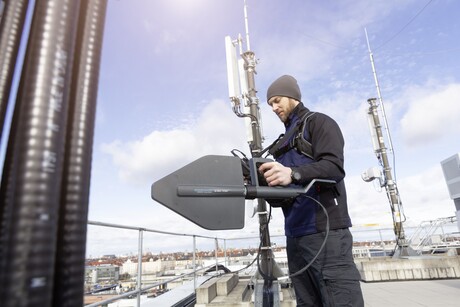
Field work can be started once this general geographic area has been identified. Vehicle-mounted automatic direction-finding or drive test systems can be used in this phase, although handheld antennas and portable instruments are also effective tools. If the interfering signal is visible over larger distances, bearings and triangulation may be used to estimate the interferer’s position. The goal in this stage is to restrict the search location to a walkable area such as a city block and group of buildings.
The final step in interference hunting involves walking around the suspected interferer location and taking measurements using a handheld instrument and directional antenna. Here, the usual methodology is to scan or sweep buildings or structures, concentrating on devices that are known radio frequency emitters, such as antennas and electronic devices. Unlike the first two steps, this step often requires physical access to private property or premises.
Interference hunting tools
The two most common instruments that are used in interference hunting are spectrum analysers and monitoring receivers.
Spectrum analysers use a heterodyne or swept architecture. The input signal in question is converted to an intermediate frequency using a mixer, and a local oscillator provides the mix frequency. The intermediate signal is then swept past a fixed-tuned filter (the resolution bandwidth), logarithmically amplified and sent to the display.
Monitoring receivers, on the other hand, digitise the input signal and then apply a fast Fourier transform (FFT) to generate the displayed spectrum. As a result, monitoring receivers are substantially faster and more sensitive than swept spectrum analysers.
Since almost all interference hunting involves a walking/sweeping stage, it is important that instruments used in interference hunting are battery-powered, portable and reasonably rugged.
The other indispensable tools in interference hunting are antennas. In order to effectively detect an interfering signal, we need either an antenna that is matched to the frequency of interest or a wideband antenna that is capable of efficiently receiving signals at a wide range of frequencies. Although omnidirectional antennas are often used in the driving-around stage of interference hunting, locating interference sources requires the use of a directional antenna. In most cases, directional antennas are handheld Yagi, log-periodic or dipole antennas. The direction of the interference source can be determined by pointing the antenna in different directions and monitoring the signal.
There are also special direction-finding antennas that, when connected to a direction-finding receiver, can be used to automatically calculate the direction or bearing of a signal source. These systems may be based on a variety of direction-finding methods (Doppler, Watson-Watt, TDOA, correlative interferometer, etc) and are either always mounted on a vehicle or set up in a fixed location. In many cases, these systems are able to automatically determine an interferer’s location within a radius of several dozen metres.
Perhaps the most important tool in interference hunting is knowledge of radio frequency principles, propagation, signals and spectral allocations. Having the right tools, a familiarity with the signals normally found in a given region of spectrum, and knowledge of the characteristics of common interferers is essential for quick and efficient identification and resolution of interference issues.
Analysing interference
Analysing suspected interferers is important for a number of reasons, not the least of which is confirming that a received signal is actually interference. Detailed analysis of an interfering signal can also provide vital clues about its source and even its location. For example, if our interfering signal consists of a regular, contiguous pattern of 8 MHz-wide haystacks of almost identical amplitude, it is extremely likely that this signal is egress from a cable television system, and our efforts can be focused on examining cable-related infrastructure and devices (8 MHz is the typical bandwidth for a TV channel).
There are several different ways of analysing interference, and interference hunting often requires a combination of these analysis methods. The most basic method for analysing interference is visual inspection of the spectrum. The traditional method for displaying spectrum is a graph of amplitude versus frequency. In a waterfall or spectrogram display, the vertical axis represents time and different colours are used to show amplitude. This type of display is extremely useful for analysing intermittent or variable frequency signals. For most interference-hunting applications, the simultaneous display of both spectrum and waterfall provides the user with an optimal mix of information. Additional numerical data can be obtained using markers and lines.
Another useful interference analysis method is behaviour or pattern analysis. Interference sources may be continuous in nature, ie, always on, while others may be intermittent over shorter or longer periods of time. Knowing that a given type of interference only occurs during home football games at night is a powerful indicator of where that interference might be coming from. Similarly, problems that only occur when it rains or is very windy suggest outdoor sources. Possible correlation between interference and other events should always be considered, no matter how unrelated the events may seem.
Further useful capabilities for analysing intermittent interference include remotely accessing and controlling an instrument, triggering and collecting information when interesting events occur, and recording spectral data over a long period of time for later analysis. Spending hours staring at a screen and hoping to catch an intermittent interferer is not an effective or popular interference-hunting method.
Common interference types
While the variety of interference sources is almost endless, a large number of (especially narrowband) interferers often share common characteristics. An awareness of these frequently reoccurring themes can save a significant amount of time and effort when investigating potential interference sources.
It is useful to differentiate between noise created by electrical systems and noise created by electronic systems. Electrical noise sources tend to be many megahertz wide and may be periodic in frequency or time. Examples of this are emissions from electric motors, welding equipment, vehicle ignition systems, electric fences and faulty transformers/ballasts. In contrast, noise from electronic sources, sometimes also referred to as spurious emissions or spurs, are usually much narrower (less than 1 MHz wide) and tend to be continuous, although in some cases they may vary in frequency, ie, be oscillating or drifting. It is fairly safe to say that almost all consumer and commercial electronics radiate spurious emissions at numerous frequencies; it is the level of these emissions that determines whether or not they are sources of interference.
A jammer preventing communications
There are sometimes cases of deliberate interference, in which someone intentionally interferes with radio frequency communications. Unfortunately, there are many cases of individuals making unauthorised, harassing or misleading transmissions on public safety, government, commercial and amateur radio frequencies.
The other most common source of deliberate interference is jammers: devices designed to limit or deny the ability to use a certain frequency range by raising the noise floor to an extremely high level — typically around –50 dBm in the affected area. Jammers are often designed to affect particular services (GPS, Wi-Fi, etc) or frequency bands (850 MHz, 1900 MHz, etc), but often create issues for services and frequencies well outside of their target range. In order to be effective, a jammer must generate a wide, strong, continuous signal, and this makes it relatively easy to identify and locate them. Most jammers have multiple antennas (one per target service/band), but may also be disguised as everyday objects.
It is important to keep in mind that although most individuals and organisations are very cooperative in helping to resolve interference issues, persons who deliberately cause interference will often go to great lengths to disguise and deny their activities.
Summary
The rapid rise in both the prevalence and the importance of radio frequency communications has increased the significance of interference hunting as a means to identify and resolve interference issues as quickly and efficiently as possible. While there is tremendous variation in the types and sources of radio frequency interference, knowledge of common causes and characteristics, together with the use of appropriate tools and techniques, greatly increases the probability of locating and resolving these issues.
The 5G radio fog
Why do traditional spectrum analysers miss modern RF interference?
Achieve accurate RF measurements by understanding spectral purity
Selecting a signal generator with high spectral purity ensures that the measurements signify the...
Signal generators: does analog or digital make a difference?
With so many options, it's important to understand which signal generator is best to achieve...