Comms Connect Melbourne 2026: conference highlights
The critical communications industry often operates quietly in the background, with its importance becoming most apparent when something goes wrong. But as the demands placed on emergency services, utilities and other critical infrastructure operators continue to grow, the technologies and people responsible for keeping communications running have never been more important.
This was a recurring message throughout Comms Connect Melbourne 2026, held on 14–15 October, which brought together critical communications and public safety professionals from Australia and around the world to explore the technologies, networks and operational strategies shaping the industry’s future.
Opening the conference, emcee Chris Stevens reminded delegates that critical communications has never simply been about radios, towers, satellites, fibre links or spectrum. Rather, it is about ensuring emergency responders can communicate when infrastructure fails, communities become isolated and lives depend on fast, accurate information.
Australia’s experience with major disasters, including the Black Summer bushfires and the 2022 eastern Australian floods, has repeatedly demonstrated the vulnerability of communications infrastructure during widespread emergencies. These events have reinforced the importance of resilient networks capable of maintaining connectivity when power, transport and telecommunications infrastructure are disrupted.
As Stevens observed, the boundaries between land mobile radio (LMR), cellular, satellite, private and public networks, and cloud infrastructure are increasingly disappearing. The challenge for the industry is to bring these technologies together into interconnected environments that remain resilient, secure and interoperable under pressure.
Convergence shaping the critical communications landscape
The convergence of communications technologies emerged as one of the defining themes of the two-day conference.
Discussions explored Australia’s evolving Public Safety Mobile Broadband (PSMB) initiative, the future of P25, interoperability, hybrid communications, private wireless networks and satellite connectivity. A recurring message was that the future of critical communications will not be defined by one technology alone, but by the ability to combine existing and emerging platforms to meet operational requirements.
Stevens reinforced this point by highlighting the importance of retaining the capabilities of established LMR systems while integrating broadband, satellite, cloud platforms and artificial intelligence (AI).
“The future of critical communications is not going to be defined by a single technology alone,” Stevens said.
He also emphasised that Australia’s PSMB development represents more than simply delivering another communications network. Its broader objective is to create an environment where emergency services can communicate, share information and operate together, regardless of agency, jurisdiction or technology.
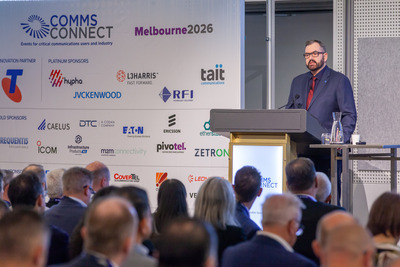
This need for collaboration was reinforced throughout the conference, with a range of industry representatives contributing perspectives on the challenges and opportunities ahead.
Hybrid connectivity brings communications to the field
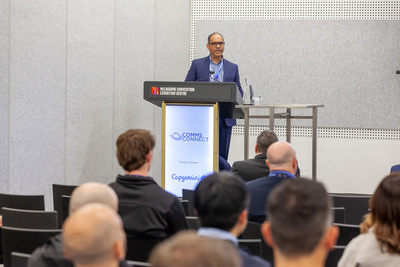
Demonstrating how these developments are already delivering practical benefits, David D’Souza, ICT & Operational Technology Leader at Powercor, outlined the organisation’s journey towards providing continuous connectivity for crews operating across rural and remote Victoria.
In his presentation, D’Souza explained that Powercor’s transformation was not simply a technology story, but one about making connectivity an essential operational capability supporting workforce safety and reliable electricity delivery.
“Connectivity isn’t a convenience, it’s a safety capability,” he said, highlighting its importance in allowing crews to access work instructions, communicate with control centres and respond to incidents while working in isolated environments.
Powercor serves urban and rural communities across western and northern Victoria, including geographically dispersed areas where reliable cellular coverage is often unavailable.
The organisation began addressing this challenge in 2018, working with partners including Ericsson to deploy truck-based 4G hotspots. These provided field crews with access to operational information and work instructions without having to return to their depots.
However, cellular black spots continued to present challenges, particularly when crews were responding to incidents or restoring electricity following severe weather.
“The ability to receive updated instructions or access our systems and communicate with dispatchers can directly affect their productivity and safety,” D’Souza said. “That’s when we realised we needed to rethink our goal. Instead of asking our crews to find connectivity, we needed to bring that connectivity to them.”
The next phase of the project involved moving beyond traditional cellular connectivity. Beginning with a pilot in 2025, Powercor introduced a hybrid solution combining Cradlepoint routers, Starlink satellite connectivity and 5G capabilities. Satellite provides the primary connectivity path, with cellular offering redundancy.
The solution has since expanded across more than 250 trucks, with cloud-based management through platforms such as NetCloud supporting monitoring, management and fleet-wide updates.
D’Souza identified four key areas of benefit: safety, simplicity, service quality and operational impact. Importantly, extended Wi-Fi capabilities allow field personnel, support vehicles and operational teams to remain connected across an entire worksite, improving situational awareness and coordination.
Powercor’s experience demonstrates the importance of ensuring reliable connectivity wherever critical work takes place. However, as communications networks continue to evolve, the opportunities extend well beyond simply keeping people and devices connected.
5G opens new possibilities for public safety
This was explored by Yasin Khan, CTO, Mission-Critical Networks & Enterprise at Ericsson, who examined how 5G could introduce an additional dimension to public safety communications through integrated sensing capabilities.
In his presentation, Khan discussed how the introduction of 4G transformed public safety communications by extending capabilities beyond voice and push-to-talk services to include mission-critical data and video. This enabled first responders to incorporate connected cameras, drones and other devices into their operations, improving situational awareness.
The next generation of connectivity is expected to extend these capabilities further, particularly through data-intensive applications such as connected drones.
Khan highlighted the potential for drones to support search-and-rescue operations, allowing emergency services to assess dangerous environments and identify people or assets requiring assistance before placing personnel in harm’s way.
“Since the 2G days of 1991, every generation of mobile communication has focused on connecting. We are not just going to be connecting now — we are also sensing,” Khan said.
He also discussed the potential for 5G networks to support sensing capabilities that complement existing technologies such as radar, optical and acoustic sensors.
Traditional sensing technologies can experience limitations in certain environments, including difficulties detecting low-altitude objects or maintaining accuracy in poor lighting and noisy conditions. By augmenting existing systems with 5G sensing capabilities, the aim is to provide more comprehensive detection and tracking information, helping control room personnel make better-informed decisions.
The objective is not to replace existing sensing technologies, but to combine their strengths to improve accuracy and situational awareness.
While integrated sensing could provide emergency services with greater visibility of developing situations, the increasing volume of information generated by connected devices, sensors and communications networks also presents another challenge: how to process and interpret that information effectively.
AI reshapes emergency communications
As communications networks become more sophisticated and connected devices generate increasing volumes of information, emergency communications centres face a growing challenge: making sense of it all. AI is increasingly being viewed as part of the solution, offering new ways to process information and support faster operational decision-making.
Louise Francis, New Zealand Country Manager for Ecosystm, explored the growing role of AI in her presentation, which saw her identify eight converging forces driving the adoption of AI: information overload, increasing operational complexity, workforce pressures, the need for continuous situational awareness, climate change, critical infrastructure security, language accessibility and the need to better coordinate multiple incidents.
She highlighted how emergency communications centres are increasingly required to process information from multiple sources, extending well beyond traditional voice calls to include video, connected devices, sensors and Internet of Things technologies.
“The challenge is that humans cannot effectively process the amount of data that’s coming in,” she explained, describing the growing information demands being placed on emergency communications personnel. The volume and complexity of this information are placing growing demands on human operators, while workforce shortages, stress and burnout are creating additional challenges for the sector.
Francis also discussed the shift from responding to individual incidents towards maintaining continuous situational awareness, with AI offering potential to help organisations analyse information and support operational decision-making.
However, she cautioned against allowing technological hype to overshadow practical and ethical considerations. Referencing the predictive crime technology depicted in the film Minority Report, she raised important questions about accountability and responsibility when AI is used to inform decisions.
The challenge, she suggested, is no longer simply whether AI can achieve something, but whether it should.
Together, the presentations highlighted how the critical communications environment is evolving: from providing reliable connectivity, to generating richer operational information, and ultimately supporting more informed decision-making.
Collaboration remains central to innovation
While technological innovation featured prominently throughout Comms Connect Melbourne, collaboration remained a consistent message across the two days.
Opening the second day, Stevens reflected on the industry’s often-unseen contribution to public safety, infrastructure resilience and essential services.
“Our industry often operates quietly in the background. When our communications systems are operating smoothly, most people don’t know we exist. It’s really when everything goes wrong that we come out into the limelight,” Stevens said.
He highlighted the importance of bringing together engineers, technicians, network planners, emergency services personnel, integrators, policymakers and operational teams to address the challenges facing the sector.

Stevens also cautioned against allowing technological hype to overshadow operational requirements, emphasising the need for systems that deliver genuine value to the people relying on them.
“In critical communications, we don’t need systems that simply sound intelligent. We need systems that are operationally intelligent,” he said.
The conference program also emphasised the importance of interoperability and cooperation across emergency services, utilities, transport and other sectors, where reliable communications are essential to everyday operations and emergency response.
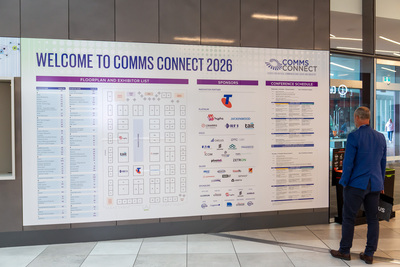
Ultimately, Comms Connect Melbourne 2026 reinforced that the future of critical communications will depend on more than technological advancement. It will require resilient and interoperable networks, intelligent systems that deliver meaningful operational benefits, and continued collaboration between the organisations and people responsible for keeping communities connected when it matters most.
ARCIA update: Gala Dinner highlights
Attendance at both Comms Connect and the ARCIA Gala Dinner & Excellence Awards included...
Laurie Colvin: a lifetime pushing the boundaries of radio
Laurie Colvin's 50-plus years in the radio communications industry have been defined by...
Call for closer critical comms cooperation in a volatile world
The critical communications community needs to strengthen cooperation across government, users...