From voice to video: the evolution of frontline communications
By Tim Karamitos, Major Account Manager ANZ, Ericsson Enterprise Wireless Solutions
Monday, 02 November, 2026
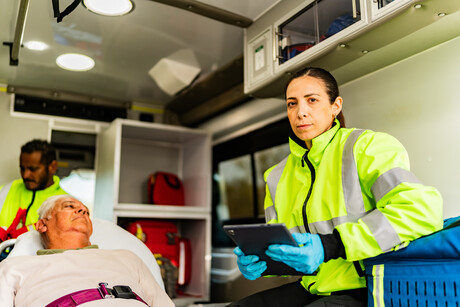
Emergency services operate in environments where delays can mean the difference between a life saved and a life lost. As Australia enters the higher-risk summer season, bushfires, severe storms and floods place added pressure on frontline teams. Reliable connectivity is fundamental to keeping crews informed, coordinating resources and maintaining a clear operational picture as conditions change.
For decades, push-to-talk voice communications across two-way radios and related applications have been the backbone of frontline coordination. Voice remains essential, but today’s first responders also depend on computer-aided dispatch, live video, GPS and automatic vehicle location, digital patient records, body-worn and vehicle cameras, sensors, mapping, and drones. These tools are only as effective as the connection behind them — particularly in the field and in vehicles, where coverage and network conditions can change from one minute to the next.
The challenge is therefore not simply to connect more devices. It is to create a resilient communications foundation that helps emergency services use familiar operational technology more efficiently and accurately, while also supporting newer capabilities that require greater bandwidth, lower latency, and consistent performance.
Why frontline teams need more than voice
Voice communication remains vital when crews are moving quickly, wearing protective equipment or working in difficult conditions. Increasingly, however, it sits alongside real-time data and video. A responder may need to receive dispatch information, view maps, share images from the incident site, update a record and maintain contact with a control centre — all during the same operation.
Connectivity also improves the value of equipment emergency services have used for years. Reliable links can keep mobile data terminals, vehicle-location systems, cameras, healthcare sensors, and patient-care devices connected to the people and platforms that act on their information. At the same time, they enable newer technologies such as drones to transmit live imagery and support search and rescue. Reliable connectivity also helps support the rising prevalence of AI in emergency services, which helps frontline workers reduce time and effort in paperwork by using AI to detect and transcribe voice recordings from body cameras to create incident reports that workers need to just review and complete.
Closing the connectivity gaps on the move
The importance of connectivity resilience was a consistent theme at this year’s Comms Connect event in Melbourne, where Ericsson’s conversations with emergency services providers focused on the criticality of connectivity in the field and in vehicles. First response workers routinely move between metropolitan, regional and remote environments, through areas where signal strength, congestion and available networks vary. A connection that works at headquarters is not enough; operational applications must remain usable as vehicles move and conditions deteriorate.
This requires more than a single mobile hotspot. Purpose-built in-vehicle dual-SIM routers can use multiple cellular connections that seamlessly transition between mobile networks to keep them connected to the strongest signal available or, where there is no cellular connectivity available, connect to an additional low-Earth-orbit satellite as another path where appropriate. Ericsson Cradlepoint solutions use wireless-optimised SD-WAN to monitor link conditions and steer applications across cellular, satellite and other available connections. Intelligent Link Bonding can use flow duplication, flow balancing or bandwidth aggregation so critical traffic can travel over more than one path, workloads can be distributed intelligently, and bandwidth can be combined for data-intensive applications such as live video.
Making voice, video and data mission-critical
Resilient in-vehicle connectivity is one part of a broader operational model. Wireless WAN can keep vehicles, crews and temporary sites connected on the move; however, given that cellular coverage varies widely — especially between metropolitan areas and regional/ remote areas — the objective is not to select one network for every situation, but to combine technologies so voice, video and data remain available across environments.
Mission-critical services also need traffic prioritisation, consistent performance and strong security. Policies can give dispatch, push-to-talk, telemetry or clinical applications precedence over lower-priority traffic, while centralised management can help ICT teams monitor routers, links and application performance across a distributed fleet. This visibility is important when agencies need to identify a degraded connection early and respond before it affects operations.
Australia’s new Temporary Disaster Roaming capability adds another layer of community resilience. Announced by the Australian Telecommunications Alliance and available from 1 October, it may allow people in designated regional or remote disaster areas to make calls, send texts and access basic data through another available cellular network when their usual network is disrupted. It is an important additional capability, but it is not a substitute for agency-grade resilience: activation depends on another network being available with sufficient capacity, and frontline operations may require higher performance and broader device support than basic roaming provides.
Building the foundation for what comes next
The evolution of frontline communications is not about replacing voice. It is about integrating voice with video, data and automation in a way that makes each capability more useful. As AI-assisted analysis, connected sensors, drones and other emerging tools become more common, they will increase both the opportunities and the demands placed on emergency services networks.
For Australian emergency services, the priority is a connectivity strategy designed around operations: where crews work, how vehicles move, which applications are mission-critical and what should happen when a link degrades or fails. By combining cellular and satellite connectivity, intelligent traffic management and fit-for-purpose network options, agencies can strengthen the tools they already rely on and create a practical foundation for what comes next — helping frontline teams act faster, share more accurate information and stay connected when every second counts.
Modern station alerting reduces the toll on firefighters
A new generation of fire station alerting systems is improving communications reliability while...
Body cameras enhance safety at Dortmund Hospital
Following a rise in aggression towards healthcare workers, Dortmund Hospital equipped its...
After 600 days of Trump 2.0, how has telecom been impacted?
At 600 days, Donald Trump's second presidency has created a more interventionist environment...