Radio telescopes enable real-time tracking of orbital threats
An international research team, led by the University of Birmingham, has successfully demonstrated how existing radio telescopes can be repurposed as independent radar receivers to improve our ability to detect, track and characterise satellites and space debris in orbit — and all in real time.
Traditional radar systems can track objects in low Earth orbit (LEO) — but detecting satellites and debris in geostationary orbit (GEO), some 36,000 km from Earth, requires extremely powerful transmitters. GEO hosts many of the world’s most critical space assets — including military, government and commercial communications, navigation and weather satellites — and protecting these high-value systems requires a clear and continuous picture of what is happening in space. This means being able to spot, track and identify all objects nearby, so that operators can make informed decisions and respond quickly to potential risks.
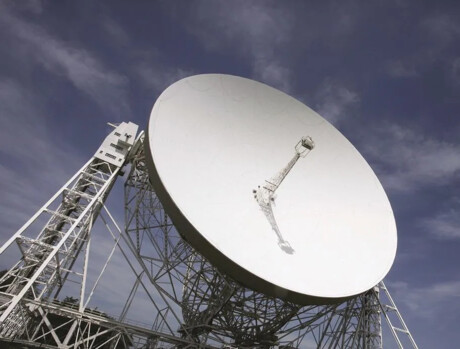
The good news is, radio telescopes like the 76 m Lovell Telescope, which is part of the e-MERLIN array operated by The University of Manchester at Jodrell Bank Observatory, are designed to detect the faint natural radio emissions from stars and galaxies, while large deep-space communications antennas routinely receive extremely weak signals from distant spacecraft. By using these assets as geographically distributed radar receivers, the sensitivity of existing radar systems can be increased by more than tenfold, enabling the detection of smaller objects at much greater distances.
To make this capability useful for space operations, the radar echoes received at the radio telescopes need to be collected, processed and analysed in real time. This is the goal of the Long Baseline Multistatic Radar (LBMR) project, funded by the UK Space Agency.
“So in the last few years, we’ve developed … this technique of combining powerful space radars with radio astronomy antennas — but it was taking us a while to capture the data and process it, to make measurements of these objects in space or to even make images of them,” said Simon Garrington, e-MERLIN Director at The University of Manchester.
“But the people who want to know about what satellites are doing in space, what threats there might be to them — whether those are hostile threats or natural threats like space debris — they want to know right now what’s happening. So the push of this project was to be able to do that bistatic radar and get those results in real time.”
The project brought together partners from the UK, the US and Australia to overcome key challenges in synchronising, distributed sensing and real-time processing — and their work finally came to fruition in July, during a live event held at the European Space Agency’s ECSAT facility in Harwell, in South East England. Here, key stakeholders from the government, defence and industry in the UK and Australia observed radar detections and measurements being processed in real time, thanks to the repurposing of major scientific infrastructure including the Lovell Telescope and e-MERLIN.
“We had transmissions from radars in the US, received by radio telescopes here in the UK, and we’re capturing that signal, processing in real time, and showing it to the stakeholders here in real time on the screen,” Garrington said. “And that’s the first time that’s ever been done.”
According to Professor Marco Martorella, Chair in RF and Space Sensing at the University of Birmingham, the successful demonstration of LBMR marks an important step towards using this technology to monitor satellites and debris around our planet.
“LBMR also provides a unique platform to advance radar technologies, validate new sensing concepts, and train the next generation of RF and radar engineers,” Martorella said. “Building and retaining this expertise is key to developing the capabilities needed to detect, track and identify space objects. This will help to protect critical space infrastructure, ensuring the safe and sustainable use of space for the future.”
Garrington added that LBMR currently uses one antenna at a time as the receiver, “and that gives us very precise measurements of the distance of the object and the rate at which that distance is changing”. The next goal for the project partners, he said, is to use multiple antennas simultaneously as receivers — a task for which the e-MERLIN radio telescope network would be ideal.
“If we can use those simultaneously, then we can get measurements of where things are in 3D in space,” he said.
Unfortunately, the future of e-MERLIN is currently in doubt, with the UK’s Science and Technology Facilities Council (STFC) recently announcing plans to withdraw its funding for the network at the end of the current contract period in March 2028. Jodrell Bank is currently working with its partners to explore alternative sources of funding, while leading scientists have called for the decision to be reversed.
Private 5G trial opens new chapter for underground mine comms
The trial evaluates how private 5G could support the next generation of connected underground...
RFUANZ report: he tāngata
In a country where landscape, distance and demands of essential services can make reliable...
ARCIA update: events season in Victoria
ARCIA has taken part in multiple events in Victoria in recent weeks, with the season set to...