Private 5G trial opens new chapter for underground mine comms
A major Australian field trial has demonstrated the potential of private 5G Standalone (SA) technology to deliver reliable, high-performance communications in the challenging environment of underground coalmining.
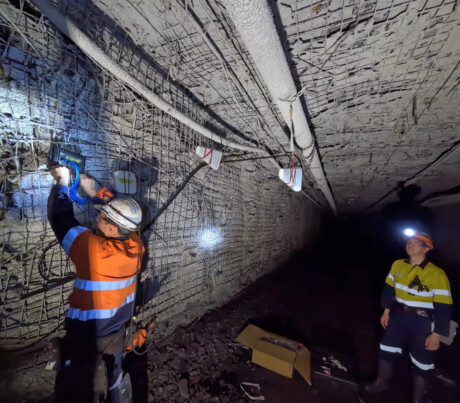
Conducted under ACARP Project C38001 at a coalmine in Queensland’s Bowen Basin, the trial evaluates how private 5G could support the next generation of connected underground mining operations.
The trial was conducted entirely underground, under representative mining conditions rather than in a lab or on the surface. It assessed private 5G’s ability to provide reliable communications through underground roadways and obstructions, maintain connectivity while users were moving, and support demanding applications including live voice and video.
RFI Technology Solutions was engaged to design, procure, integrate, commission and support the private 5G system used in the trial — and the results demonstrated that private 5G SA can provide sustained live voice and video communications, mobile connectivity and multi-cell handover in an underground environment.
The network successfully restored connectivity as users moved beyond the effective coverage area of an individual cell, demonstrating the potential for continuous communications across larger underground operating areas. For mining operators increasingly adopting automation, remote operations, connected vehicles and video-based applications, this capability matters.
“This trial shows private 5G can now be evaluated in a real underground environment, not just discussed as a future possibility,” said Scott Magee, CEO of RFI Technology Solutions.
“The ability to support voice, video and mobility in challenging underground conditions provides an important foundation for the next generation of connected mining operations.”
A key outcome of the project was the demonstration of different approaches to distributing 5G coverage underground. Both conventional antennas and radiating coaxial cable were successfully deployed, providing flexibility to adapt network infrastructure to underground roadway geometry, existing infrastructure and operational requirements.
RFI’s Digital Drift technology formed an important part of the trial architecture, enabling power, Gigabit Ethernet data and RF services to be distributed over a common coaxial cable. The self-contained system incorporated two 5G small cells, a local standalone 5G core and battery-based power supplies; this enabled the network to operate without access to underground mains power, internet connectivity, GNSS or Precision Time Protocol synchronisation.
The deployment also demonstrated the practicality of rapidly establishing a private 5G network underground. Following installation of the radiating cable by the mine’s electrical team, the communications system was installed and commissioned in approximately one to two hours. The complete test program was then conducted before the equipment was removed later the same day, minimising disruption to mine operations.
The trial also replicated, as far as practicable, testing previously undertaken using Wi-Fi mesh technology. This allowed private 5G performance to be assessed against comparable underground scenarios, including communications range, obstruction tolerance, non-line-of-sight performance, mobility and service continuity.
The findings showed that private 5G delivered performance comparable to the previously tested Wi-Fi mesh system for sustained live voice and video communications under equivalent conditions. Private 5G also offers additional capabilities relevant to large-scale mining operations, including managed mobility, quality-of-service controls, support for larger device populations, and integration with advanced security and network-management functions.
The project also identified challenges that must be addressed before widespread adoption, particularly the availability of appropriately certified 5G radios and user equipment for hazardous underground environments. Continued collaboration between mining companies, telecommunications providers, system integrators and equipment manufacturers will be important in overcoming these barriers.
“The significance of this project goes beyond demonstrating 5G coverage underground,” said Dr Mark Dunn, Senior Principal Research Engineer for CSIRO Mineral Resources.
“It shows how private 5G could connect people, mobile equipment, video, sensors and other operational technology across the digital mine.”
The findings provide a technical foundation for continued evaluation of private 5G in underground coalmining, including through longer-duration and larger-scale operational deployments. For Australia’s mining industry, the trial adds underground evidence to the case for private 5G in supporting automation, mobility, real-time information and digitally enabled operations.
Phone: 1300 000 734
Nokia FastMile 5G receiver and 5G Gateway 7
The devices are designed to enable operators to conserve radio capacity and improve coverage of...
D2UNet cybersecurity services
D2UNet collaborates closely with clients, focusing on their network structure, availability,...
Keysight multi-industry conferences
Keysight Technologies is holding its Keysight multi-industry virtual live conferences from 23 to...