Improving firefighter readiness through modern station alerting

Fire stations around the world have traditionally relied on audible tones, overhead paging systems and station lighting to alert responders to emergency incidents. While these systems have served the fire service for decades, they can leave gaps in both alerting effectiveness and firefighter health.
Depending on sleep stage and fatigue levels, responders may wake slowly, miss portions of dispatch information or, in some cases, sleep through station tones altogether. As departments seek to improve alerting reliability, many are looking beyond traditional systems designed around a station, towards more responder-focused approaches that utilise multiple forms of notification.
At the same time, sleep health has become an increasingly important topic across the fire service. Growing research continues to connect sleep quality to firefighter health, performance and overall wellness. Poor sleep has been linked to impacts ranging from cognitive performance and decision-making to cardiovascular health, mental health, cancer risk, eating habits and long-term wellbeing. As a result, alerting systems have become an important area of focus for departments seeking to improve the station environment and better support firefighter health.
Across the United States, fire departments are increasingly adopting multimodal alerting systems that combine tactile, visual and audible notifications. Rather than depending primarily on loud tones and hardwired infrastructure, these modern systems deliver incident information through multiple pathways simultaneously, helping ensure critical alerts are received regardless of where personnel are located within the station or how deeply they may be sleeping.
A significant component of this evolution is zoned alerting. Traditional station alerting systems frequently wake an entire station regardless of which crew or apparatus has been assigned to the incident. Modern alerting systems allow departments to wake only the firefighters assigned to a specific call, reducing unnecessary sleep interruptions for crews who are not responding.
EaseAlert is one example of this shift towards responder-focused alerting. Fire departments throughout the United States are using wireless tactile and visual alerting technology to enhance the alerting process and improve notification reliability. Through zoned alerting, only the personnel assigned to an incident are woken up, while crews not associated with the call can continue resting. Responders receive vibration-based notifications through bunkroom and wearable devices, while visual indicators throughout the station provide additional awareness that an incident has been dispatched.
The system’s wireless architecture allows it to be deployed in virtually any environment, whether retrofitting an existing station or being incorporated into a new station design. Departments can modernise alerting capabilities without the extensive wiring, conduit installation and facility modifications often associated with traditional hardwired alerting systems.
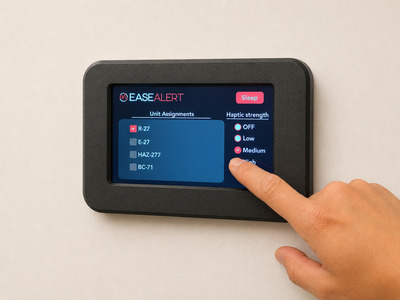
The growing interest in responder-focused alerting is also supported by emerging research. An NIH-funded clinical study conducted by researchers from the Center for Fire, Rescue & EMS Health Research (CFREHR) and Embry-Riddle Aeronautical University evaluated firefighter responses to traditional audible alerting systems and EaseAlert. The study involved 48 firefighters from five fire stations in the Midwest United States. Researchers found that heart-rate spikes during the first 30 seconds following an alert were as much as 38.3% lower when using EaseAlert compared with traditional alerting methods. The same study found that participating firefighters reported a 169% improvement in perceived health impact after transitioning from their traditional alerting system.
Across the fire service, the conversation is shifting from simply ensuring firefighters hear an alert to ensuring they receive it in the most effective way possible. By combining tactile, visual and audible notifications with targeted zoned alerting, departments are creating more reliable alerting environments that support operational readiness while promoting firefighter health and wellness.
As agencies continue to modernise communications infrastructure and prioritise responder wellbeing, responder-focused wireless alerting systems are becoming an increasingly important component of the modern fire station. The future of station alerting is not simply about waking firefighters. It is about helping the right firefighters receive the right information, at the right time, in the healthiest and most effective way possible.
Phone: 1300 001 875
Codan VaaN 2.0 firefighter-assured communications concept
Codan's Vehicle as a Node 2.0 (VaaN 2.0) concept transforms frontline appliances into...
m-View Matrix body-worn cameras
m-View's Matrix body-worn cameras are purpose-built for frontline environments, offering...
Airbus Agnet Direct multimode connectivity for MCX users
Agnet Direct is a multimode solution that allows mission-critical applications (MCX) users, such...