Video to the rescue: enhancing emergency response and public safety operations
Monday, 04 May, 2026

Mission-critical video is an integral part of the 3GPP MCX mission-critical communications standards, designed to meet the rigorous demands of public safety applications.
Video has emerged as a transformative tool in public safety by offering real-time, on-the-ground intelligence that allows command centres and field teams to make quicker, better-informed decisions. Unlike traditional data forms like voice and text, video provides an unfiltered view of unfolding events, offering unparalleled context that can reduce misunderstandings and errors in assessment.
The proliferation of smart devices, high-speed mobile broadband and high-definition cameras — and the ever-decreasing costs of such technologies — means that video is increasingly accessible to public safety agencies, helping first responders to monitor police operations, coordinate rescue operations, or assess crowd density at large public events. Video technology continues to evolve from its origins in fixed surveillance, adapting to the mobility and interoperability requirements of modern emergency response.
Applications of video don’t stop at public safety use cases. Railways, oil rigs, mining, transportation and utilities all have their unique applications for video communications, furthering the case for the widespread adoption of video communications for the benefit of all critical communications users.
Public safety broadband networks
Ubiquitous mobile broadband enables new applications to be deployed in mobile networks, taking advantage of transmission speed, high bandwidth, prioritisation and reliability in multiple verticals, including public safety communications.
The Public Safety Broadband Network (PSBN) concept stems from the need for dedicated, high-resilience networks that can handle the intense demands of public safety operations, especially during emergencies when commercial networks are often overloaded. Established PSBNs, such as SafeNet in South Korea, FirstNet and Critical Linc in the United States, ESN in the UK and similar initiatives in countries around the world, were designed to offer reliable, secure, dedicated bandwidth that prioritises emergency responder traffic over regular network usage.
PSBN infrastructure is built upon LTE and, increasingly, 5G technology, enabling high-bandwidth applications such as video streaming, real-time location tracking and data sharing. PSBNs usually operate on dedicated frequency spectra, typically below 1 GHz, to ensure greater range and penetration in urban and rural settings, giving responders communication capabilities even in remote or disaster-stricken areas.
PSBNs provide a controlled environment where data is prioritised, secured and optimised for mission-critical applications, making PSBNs invaluable in improving the responsiveness, coordination, and efficiency of public safety agencies across regions and states. Public Safety Broadband networks are actively developing around the world, and it is important to note that all include MCVideo as one of the core requirements, alongside MCPTT and MCData support.
Video communications in public safety today
Public safety video communications have transformed in recent years thanks to the power of LTE and 5G networks. Modern broadband networks are the primary carriers for video data, especially in urban areas, where they offer the bandwidth and speed necessary for high-definition, low-latency video streaming. In more remote areas, agencies often rely on satellite and mesh networks to maintain connectivity and enable video communications.
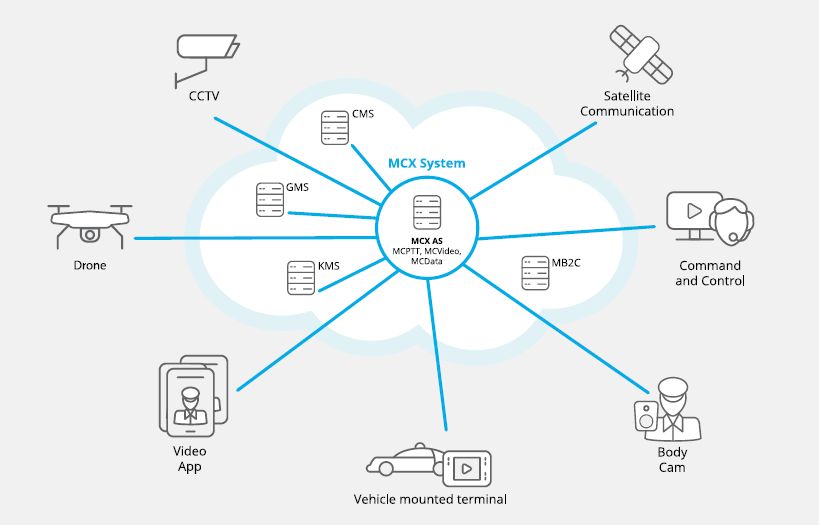
Different video sources serve various roles in public safety today, including fixed surveillance cameras in public areas and facilities; body-worn cameras providing first-person footage; drone footage offering aerial views; and citizen-generated content. In this complex environment, video feeds need to be aggregated and analysed in real time by command centres, enabling dynamic resource allocation, risk assessment and scenario planning.
What is mission-critical video?
Mission-critical video (MCVideo) is an integral part of 3GPP MCX standards-based mission-critical communications, alongside MCPTT and MCData. MCVideo was specifically designed to address the needs of first responders and other critical communications users, and enables both group calls and private calls.
MCVideo is a type of video service designed explicitly to meet the rigorous demands of public safety applications. Unlike commercial video services, MCVideo prioritises low latency, high quality and secure data transfer.
Why MCVideo?
The unique demands of public safety situations require MCVideo’s robust architecture to handle high-stakes scenarios where video clarity, timing and reliability are crucial. MCVideo enables agencies to visualise active threats, monitor responder safety and coordinate responses effectively. It helps provide situational awareness, allowing command centres to monitor events in real time and make informed decisions based on reliable visual data.
Compared to traditional video solutions, MCVideo offers end-to-end encryption, resilient streaming and dynamic bandwidth allocation, which ensures that video quality remains high and accessible despite potential network strain. MCVideo can also be tailored to work alongside other mission-critical services, such as MCPTT (push-to-talk), enabling a multifaceted approach to managing public safety incidents.
Use cases in public safety video
Bodycams
Body-worn cameras are used extensively in public safety, particularly by law enforcement agencies, to capture footage of interactions, document incidents, and provide an unbiased record of events. Privacy and data management are critical challenges, as bodycams generate substantial data volumes, and content must be stored, accessed and secured following legal standards.
Enabled with MCVideo capabilities, bodycam video can be shared live within a group of first responders working on specific tasks, greatly increasing situational awareness and enhancing efficiency of the response for every team member and the group overall.
Drones
Drones provide public safety agencies with aerial surveillance that can reach areas inaccessible or dangerous for personnel. Common applications include search and rescue, monitoring large crowds, assessing damage during natural disasters, and surveilling areas during incidents like fires or hazardous material spills. Drones are effectively already proven in firefighting response, allowing firefighters to have a full operational view of the situation.
Equipping drones with MCVideo capabilities will allow seamless and secure delivery of the video stream to the command-and-control centre where it can be not only shared with the response team but also processed by an AI-equipped analytics engine, improving the efficiency of the response.
Citizen video
911/000 today is largely limited to the voice, and increasingly, mobile text message interactions with emergency response centres. At the same time, the majority of emergency calls today are made using mobile smartphones, typically equipped with advanced video and photo capabilities.
Integrating MCVideo with emergency call centres and dispatch operations would represent a leap in emergency response capabilities, allowing citizens to share photos, videos and other digital media directly with emergency dispatchers. Implementing this type of citizen-generated content requires efficient data workflows to ensure that video and other media are received, processed and utilised while protecting privacy.
Mission-critical video communication for first responders
MCVideo allows first responders to make video calls to groups or individuals, stream video from drones or security cameras and share video content securely. These capabilities offer numerous benefits to first responders such as enhanced situational awareness through real-time video sharing, improved decision-making with visual information from the field, ability to collaborate visually across agencies during emergencies, and secure and prioritised video communications on dedicated public safety broadband networks.
Railways
Railways use video for continuous monitoring of station platforms, on-board trains, and along the tracks to identify safety hazards, manage incidents and comply with safety regulations. Video in rail systems supports quick detection and response to emergencies, allowing staff to monitor train activity, passenger movements and operational conditions in real time. As an added benefit, video footage is also used for post-incident analysis, contributing to improved operational safety and efficiency.
Important considerations for delivering high-quality real-time video over mobile broadband
Real-time video faces several technical challenges in the public safety context, including:
- Bandwidth and latency constraints: Video streams require significant bandwidth, particularly high-definition or multi-camera set-ups.
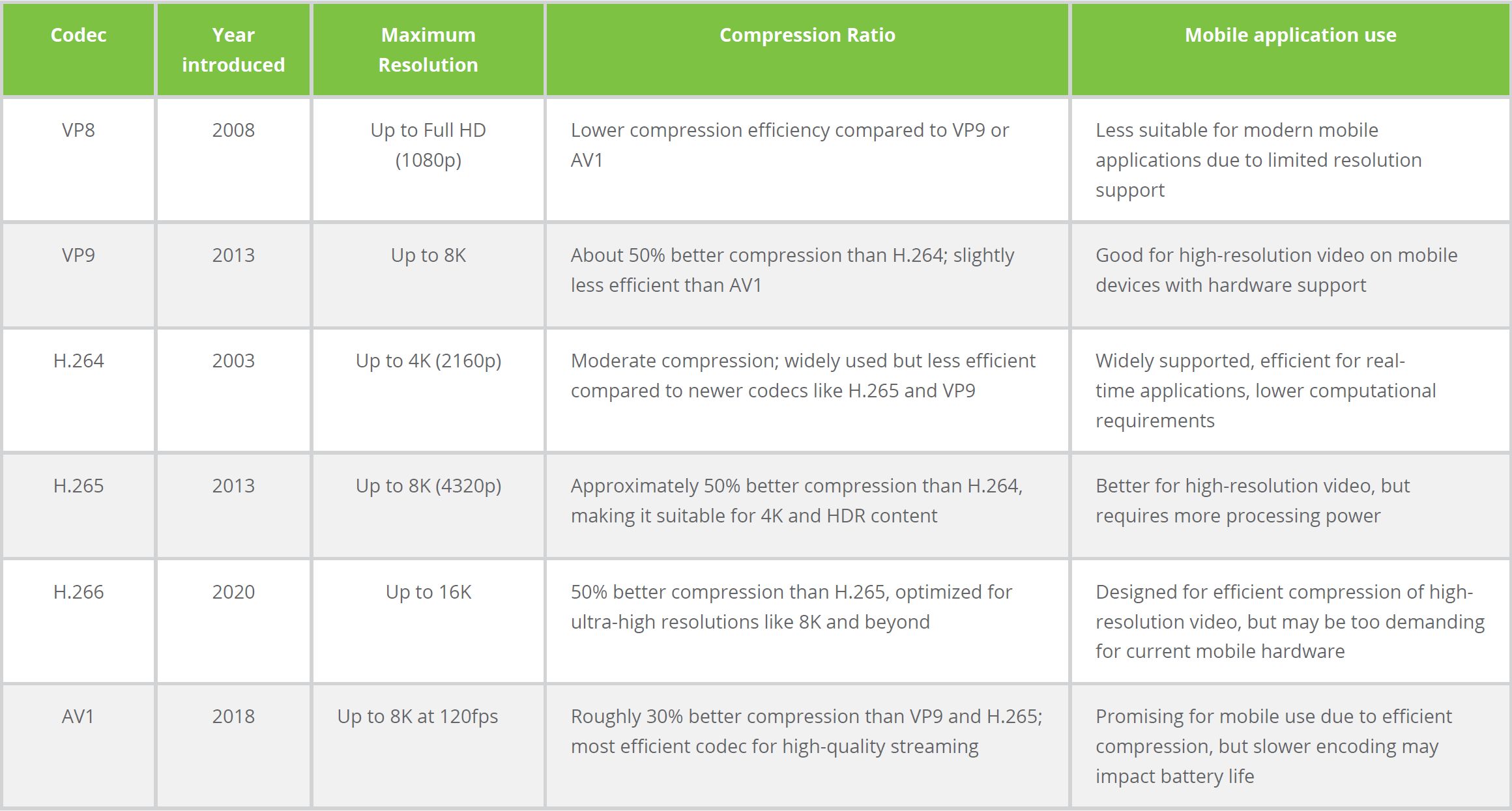
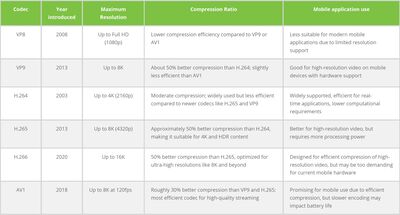
- Codec optimisation: Codecs like H.264, HEVC (H.265), and VP9 compress video to manage bandwidth, but each has trade-offs between quality and resource efficiency. Choosing the right codec is essential to ensure quality without excessive network strain (see Table 1).
- Media management: Storage, access and retrieval of vast amounts of video data can quickly become complex, requiring efficient media management systems that can store, archive and secure video data for retrieval when needed.
- Mass video delivery: Networks need to be ready and capable to process mass amounts of video. Enhanced Mobile Broadcast (eMBMS) is an essential networking technology which needs to be adopted by public safety service providers to ensure continuous uninterrupted video communications delivery in such cases.
Challenges in developing video-enabled communication solutions
Hardware limitations
Most endpoint devices are resource-constrained, with limited processing power, memory and battery life. These constraints impact the ability to handle computationally intensive video processing tasks such as encoding, decoding and rendering.
Hardware needs to leverage dedicated video processing hardware, such as GPUs or video decoding chips, to offload computational tasks, and utilise power-efficient designs that balance performance and thermal management.
Software complexity
Developing software that supports seamless video communication involves addressing multiple technical aspects, including compression, synchronisation and error correction. Implementing advanced codecs and optimising them for diverse hardware platforms is challenging, while maintaining audio-video synchronisation, especially in low-latency environments, requires precise timing and careful buffer management.
Adaptive streaming algorithms are needed that adjust video quality dynamically based on network conditions. Machine learning can also be used to optimise compression and enhance video quality in real time.
Network variability
Reliable video communication depends on stable network conditions, but real-world networks are often far from ideal, often with bandwidth constraints and sometimes high latency.
Employing scalable video coding (SVC) can deliver a consistent experience across varying bandwidth conditions, and quality-of-service (QoS) mechanisms should be used to prioritise video traffic.
Security and privacy
Video communication involves sensitive personal and business data, making security and privacy essential considerations. Implementing robust encryption protocols without compromising performance is critical, and compliance with regional regulations, such as GDPR or HIPAA, can complicate the deployment of global video solutions. Ensuring secure and seamless access to video services also requires sophisticated identity management.
Secure protocols, such as DTLS and SRTP, must be used to encrypt video streams, and software should be regularly updated and audited to mitigate vulnerabilities.
User experience
User expectations for video communication are higher than ever, requiring intuitive and reliable solutions. Users demand HD or 4K video and clear audio, even in suboptimal network conditions, and interfaces must be intuitive and require minimal configuration.
It is necessary to invest in good user interface and user experience design to create intuitive and accessible applications, as well as conducting rigorous testing to ensure compatibility across devices and platforms.
The future of public safety video
Public safety video is important, and we can only expect the use and the value of it will increase over time and emerging technologies will further advance MCVideo use cases. Technologies such as advanced analytics (such as facial recognition, behavioural analysis, anomaly detection, and crowd counting) as well as artificial intelligence and machine learning will revolutionise video analytics in public safety, enabling advanced functions such as predictive modelling, real-time threat recognition and object detection.
Direct mode (DRD) communication is an essential element of public safety broadband, and crucial for the success of the technology. It will be powered in the future by 5G-Sidelink technology, enabling devices to communicate directly with one another without a mobile network being present (with the caveat that real video communications are not expected to be available in D2D communications for several years). And although at least five years away from first deployment, 6G technology is still worth mentioning as we can expect that it will be a game changer for network-demanding applications such as MCVideo.
Multisite DMR system strengthens comms for mining group
Caltta Technologies has announced the successful deployment of a multisite DMR Enhanced...
Private network upgrade for industrial campus
Inrico delivered an end-to-end converged communication solution to support Yihai Kerry's...
Wireless telemetry enables smarter mine water monitoring
Omniflex has deployed a wireless telemetry system at the Nkomati Nickel mine to monitor water...