
AI at the edge: Empowering emergency services
By Jodi Favaloro, Senior Sales Engineer Consultant, Asia Pacific, Ericsson Enterprise Wireless Solutions
Wednesday, 29 April, 2026

Every year across Australia and New Zealand, ambulances make millions of trips. In New South Wales for example, patients who meet major trauma criteria should be transported to the highest-level trauma service within an estimated 60-minute travel time (metropolitan area) or 90-minute travel time (regional and rural areas). In New Zealand, an ambulance service allows 30 minutes for a crew to hand over a patient to hospital staff, complete documentation, restock and debrief.
Vital minutes are spent completing important admin tasks that could be automated. Below are some trends we’re seeing in emergency services this year.
AI allows for earlier awareness and faster decisions
Public safety teams are dealing with more data than any agency can realistically keep up with. Video feeds, tips, calls, sensor alerts and digital evidence continually stream in and add up quickly. Artificial Intelligence at the edge is making the task manageable by taking on the first pass — scanning for moments that deserve attention, such as a drop in heart rate, unusual movement, or a defibrillator being used in a vehicle. With AI at the edge, ambulance staff teams can spend less time debriefing emergency department staff and typing up notes and more time acting.
For AI to be effective, insights must move quickly enough to shape decisions in the moment. That means building a network foundation that can support high volume video and real-time data flows without slowing down during peak demand. 5G capacity and edge processing can reduce latency and keep intelligence usable when minutes matter.
Always-on connectivity with next-gen networks becomes a baseline
Mission-critical outcomes now depend on connectivity that holds up under congestion, disasters and geographic challenges. Today’s public safety agencies blend standalone 5G and network slicing to protect capacity during surges, blended cellular and satellite for coverage and continuity and edge compute to reduce backhaul strain as video and computer vision scale.
Public safety innovation is most valuable when it removes friction during response. With SD-WAN, agencies can use multi-path connectivity to steer traffic over the best available link as conditions change, such as in a moving ambulance, without responders worrying about the network during an incident.
A flexible foundation that combines cellular, satellite and intelligent traffic steering helps avoid expensive rebuilds and keeps voice, video and data moving when operations shift from routine to surge, without relying on satellite when lower-cost links are available.
Autonomous public safety systems reduce workload when the foundation is ready
Automation is expanding because agencies need to do more with fewer resources. The strongest use cases do not attempt to replace people. They’re meant to lessen the workload and help teams move faster from ‘we have information’ to ‘we know what to do next’. That can look like chat tools that handle common questions and sort non-emergency requests before they hit dispatch, intersections that adjust signals as emergency vehicles approach, always-on monitoring for critical infrastructure that flags issues sooner, and reporting tools that help cut down on paperwork after a shift.
This means more time in the field and in response, and less time buried in administrative work — with humans still making the calls.
But these tools only work if the foundation holds. First responders need reliable, low-latency connectivity and strong security at the edge, because more devices and more data also mean more points of failure. If the connection drops, the automation quickly stops being helpful.
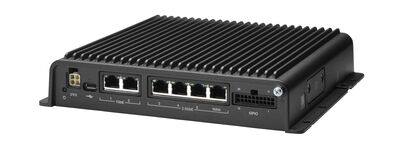
Ericsson’s Cradlepoint R2400 ruggedised router features an industry-first Dual‑SIM/Dual Standby (DSDS) on a single modem, which enables carrier switchover roughly ten times faster than previous approaches keeping voice, video and data flowing during critical events and transit routes. It also offers faster security processing, with Ericsson NetCloud SASE’s zero-trust security and SD-WAN services providing a highly secure and optimised WAN network across fleets, sites and critical assets.
As fleets adopt video analytics, environmental sensors, automated alerts and emerging AI-driven applications, traditional vehicle routers struggle to meet the demand. Many lack the processing power required to handle workloads locally, forcing data back to the cloud even when latency or backhaul limitations make that impractical. The R2400 is engineered to support these evolving needs with significantly expanded edge compute capacity. Offering 2.5 times more processing power than its predecessor, it enables organisations to run AI inference for video analytics, computer vision, people counting and containerised applications directly in the vehicle. This reduces delays, preserves bandwidth and ensures faster access to insights exactly where they are needed.
With multi-carrier 5G and edge AI, Ericsson’s R2400 can unify in-transit vitals, voice, and video so hospitals receive continuous insights and secure handovers.
The Ericsson R2400 enables:
- Sensor data reading, filtering, telemetry and simple anomaly detection
- Camera-based or audio-based basic analytics
- Image recognition and object detection
- Event detection
- Facial recognition
- Telemetry-driven predictive maintenance
- Voice activation and command recognition
- Industrial safety and security (incident detection)
- Local data pre-processing/aggregation
- People/object counting.
For agencies investing in modernisation, connectivity is the foundation, and next-generation networks make it resilient. 5G supports high-quality video and live data flows, while edge computing processes information closer to where it’s collected to reduce delays. SD-WAN routes traffic intelligently, so critical applications stay up and responsive. Together, these technologies help agencies stay connected when it matters most.
Hytera Introduces PDC580 Dual-Mode Rugged Radio to Support Seamless Communication Across Critical Operations
Hytera has announced the launch of the PDC580 Dual-Mode Rugged Radio, developed for organizations...
One network, one device: how MCPTx is replacing the two-radio problem
The IS380.1 from i.safe MOBILE addresses the problem of workers needing to carry two...
From emergency vehicle to mobile command centre
Why connectivity is the backbone of modern emergency fleets.