Comms Connect preview: how Surf Life Saving SA modernised its dispatch
SLSSA operates a safety-critical communications network supporting volunteer and professional lifesaving crews across an extensive coastline, coordinating rescues, patrols and large-scale incidents with technology that must be reliable, flexible and interoperable with external agencies.
An Omnitronics customer since 2012, SLSSA has progressively evolved its communications capability, moving from early RediTALK and RediTALK-Flex dispatch deployments to a modern omnicore Express dispatch environment that today sits at the heart of its State Operations Centre (SOC).
SLSSA’s vast coastline is served by a distributed radio network, and incident response often extends beyond its own coverage, demanding interaction with external agencies under time pressure. SLSSA previously relied on console-level audio patching to bridge networks, which was functional, but prone to audio dropouts and inconsistent performance on short transmissions as operations grew more complex.
The SOC includes highly technical users alongside other users who operate the system intermittently. SLSSA needed a solution that could scale in capability without adding operational risk or training overhead, while supporting remote access outside normal staffed hours.
The requirements were clear:
- Network-level interoperability across the Tait DMR Tier II, Motorola Phase 1 and 2 trunked P25 government networks, and VHF Marine channels;
- An interface flexible enough for advanced users and intermittent users alike, without compromising reliability or situational awareness;
- Integration with Esri ArcGIS and external recording platforms; and
- Resilience without a dedicated backup control room, built on secure remote access and network-centric architecture, protecting existing Omnitronics investment.
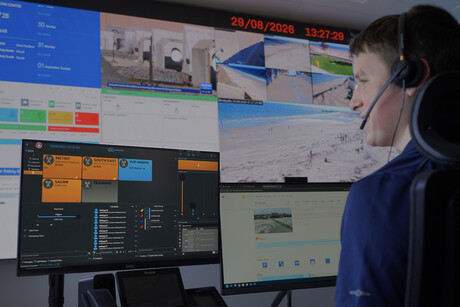
The implementation was designed and commissioned by CartGIS, and now runs across four permanent operator positions, forming the operational hub for radio, mapping, recording and interoperability. It integrates SLSSA’s coastal DMR Tier II network with the P25 network and VHF Marine channels via Omnitronics gateways, with an Eventide recorder handling voice recording and Esri ArcGIS visualising real-time location data.
A key decision saw the removal of physical radios from operator desks: operators now connect directly into the radio networks via IP, improving reliability and simplifying workstation design. Touchscreen consoles, foot pedals and wireless headsets via an omnihub2 media dock support different operating styles, while the network-centric design means the SOC can be relocated quickly if required.
omnicore Express dispatch lets SLSSA dynamically patch disparate radio networks in real time, proven when an on-call officer outside surf radio coverage patched a P25 government talkgroup into the coastal Tait DMR network, maintaining full operational control from home. Consolidating dispatch control and moving away from tablet-based workflows has cut response times: operators now establish patches, access audio and manage incidents in a single action.
The system flexes to the operator: advanced users customise screen layouts and workflows, while other users rely on simple, tactile controls, with one-touch switching between speakers and headsets reducing friction during escalation. SLSSA relies on instant recall playback, text messaging to radios, and remote radio stun and revive — the latter supporting lost, stolen or stuck-PTT radios without permanent deactivation, while text messaging helps identify unknown radios detected via AVL.
Rather than maintaining a dedicated backup control room, SLSSA relies on omnicore’s IP-based architecture and secure remote access to re-establish dispatch operations quickly from alternate locations with minimal hardware, aligning with its broader business continuity strategy.
omnicore dispatch’s intuitive interface reduces the initial training burden for staff and volunteers, and dedicated intercom channels allow realistic scenarios without impacting live operations. SLSSA is also exploring Omnitronics’ omniacademy online training resources for operator refreshers and technical upskilling.
“We don’t see Omnitronics as just a dispatch system — it’s a critical part of our entire operational ecosystem,” said Lachlan Larven, Coordinator of SLSSA’s SOC. “omnicore gives us the flexibility to work across networks, support our volunteers, and respond faster when it matters most.”
Phone: 08 9445 6800
Nokia Cognitive Operations AI and edge platform
Nokia's Cognitive Operations (CO) platform enhances site and asset intelligence for...
Aviat WTM 4400 Quad all-outdoor radio
Aviat Networks has announced the WTM 4400, also known as the Quad, which supports four...
Pivotel OneTouch SL-Mini portable satellite connectivity solution
Pivotel's OneTouch SL-Mini is a rugged, portable satellite connectivity solution designed...