
Neural network enables superfast autonomous drones
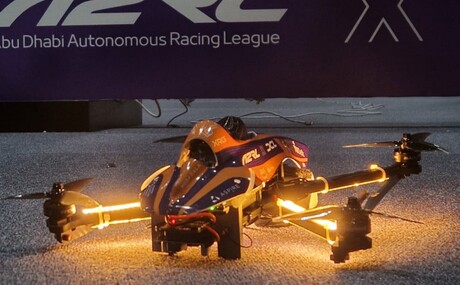
Researchers at Delft University of Technology (TU Delft) have developed an AI system that enables a racing drone to navigate demanding courses at extreme speed — even faster than human drone pilots — using only a single camera.
Published in the journal Science Robotics, the breakthrough shows how compact, neural-network-based control can achieve high-performance autonomous flight under real-world conditions. Furthermore, the underlying principles could help advance a much broader class of autonomous robots, from vehicles to mobile and humanoid systems.
The team at TU Delft set out to investigate how far artificial intelligence can push a drone with very limited sensors, onboard computing power and energy. At high speed, even a small delay in sensing or control can mean missing a gate, colliding with an obstacle, or losing control and crashing.
The result is MonoRace, an autonomous flight system developed at TU Delft’s Micro Air Vehicle Lab (MAVLab). Unlike previous autonomous racing systems, MonoRace uses just one forward-facing camera and an inertial measurement unit (IMU) for perception, navigation and control.
At high speed, the drone has very little time to interpret what it sees. A neural network identifies the racing gates in the camera images, while the onboard IMU and a model of the drone estimate its position and motion. The system does all this without GPS or external motion tracking.
“Flying at very high speed with only one camera is challenging because the images are blurry, deformed and the AI system has very little time to precisely determine where the drone is,” said Stavrow Bahnam, main author of the study.
“We developed a robust way of combining what the camera sees with the drone’s own motion information, allowing it to navigate the track at high speed without GPS.” The system also had to cope with imperfections that occur in real flight, including camera interference and sensor saturation.
The researchers also redesigned how the drone is controlled. Rather than using a conventional control system with several layers of intermediate controllers, MonoRace uses a small neural network that directly generates the commands for the drone’s motors.
The network runs onboard a tiny computing chip, the ‘flight controller’, giving control commands 500 times per second. It was trained using reinforcement learning, allowing it to learn how to control the drone while taking its physical limitations into account.
“Instead of first planning a desired flight path and conventional commands, our neural network learns to directly control the motors,” said study co-author Robin Ferede. “This allows the controller to react extremely quickly and exploit the capabilities of the drone while remaining small enough to run onboard.”
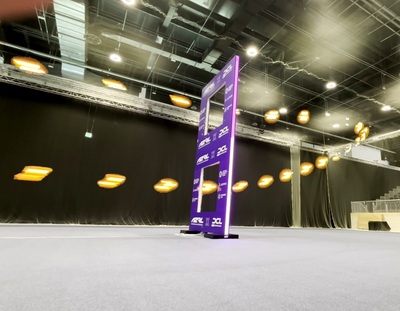
To validate the system under realistic conditions, the researchers put it to the test in a demanding international competition environment: the 2025 A2RL Autonomous Drone Championship. The drone and racing environment were designed and operated by the competition organiser — ie, the Abu Dhabi Autonomous Racing League — rather than by the researchers themselves, meaning the system had to operate successfully on both hardware and a track that the research team did not control. Despite these constraints, the TU Delft drone reached speeds of up to 100 km/h, defeating all other autonomous teams as well as three former world-champion human pilots.
“Instead of giving the robot increasingly powerful sensors and computers, we wanted to find out how much intelligence we could extract from very limited resources,” said study co-author Christophe De Wagter. “Drone racing provided an extreme environment in which to test these ideas outside the laboratory. It pushed us to develop AI that was not only fast but also robust, and able to adapt when external reference measurements were unavailable.”
For co-author Professor Guido de Croon, drone racing is just one way of pushing the developed AI to its limits, as it could be applied to many more, different real-world robotic systems.
“Here we optimised for speed, but the same approach could be used to prioritise efficiency or safety,” he said. Furthermore, the researchers believe that the same principles could help a wide range of autonomous robots make fast, reliable decisions with limited onboard resources — from vehicles and mobile robots to future aerial and humanoid systems.
Rugged tablets support SA Power Networks' field teams
Getac's ZX10 rugged tablets give SA Power Networks crews a consistent and supportable...
Comms Connect preview: connecting the NHS
Modern healthcare delivery depends on reliable and secure connectivity, yet many of the UK's...
Essential cathodic protection with web-based monitoring
Omniflex has been aiding local authorities in Queensland with the essential maintenance of...