Ranlytics launches continuous P25 network monitor
Wednesday, 06 May, 2026
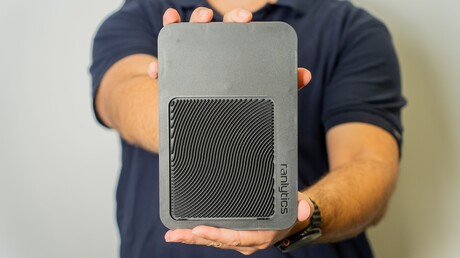
Australian RF testing technology company Ranlytics has developed what it says is a world-first way to continuously monitor cellular networks and P25 radio using a compact device that costs less than a standard mobile phone.
The KALLO device, combined with a cloud-based analytics platform, enables critical communications networks to be continuously and autonomously monitored for coverage gaps, degradations and other performance faults. Initially built to monitor cellular networks, KALLO is now capable of monitoring P25 public safety radio networks as well.
Instead of requiring field technicians to conduct periodic, hours-long walking or drive-by tests, the KALLO compact sensing device is placed in locations where coverage is required, such as in buildings, hospitals and stadiums, taking continuous measurements that offer real-time visibility into network availability and other network operational metrics.
“Radio networks, cellular and P25 are extremely dynamic and are always changing environments resulting in the owners and operators of the radio networks having to assume whether they are meeting their customer obligations,” said Peter Papaioannou, Managing Director, Ranlytics. “Because of these constant changes, operators need to either constantly go out and physically test — which is an expensive, complicated, resource-intensive and slow exercise — or do something completely different.
“By using KALLO’s cost-effective, fully automated monitoring device, network operators gain continuous real-time visibility into network performance and health. With KALLO, operators know the minute that something is starting to degrade, before this degradation results in an outage.”
Support for P25 in KALLO was made possible with R&D by Ranlytics at its Artarmon headquarters in Sydney’s north, where the devices are designed and manufactured. The company used a software-defined radio (SDR) to add P25 capability and incorporate it into KALLO. A similar process will be used for future expansions of KALLO to monitor other radio-based networks and technologies.
The ability to monitor P25 digital radio networks is important given how critical P25 is to the emergency services community in Australia and around the world. From dispatch to arrival and processing of a scene, emergency services organisations increasingly rely on P25 digital radio to communicate between different agencies on the same network. P25 is also widely used in critical infrastructure sectors such as the mining industry.
KALLO is fully automated, zero-touch and able to be cost-effectively deployed at scale to measure and monitor large network footprints. Ranlytics says its development was years in the making, particularly to ensure autonomous operation while remaining cost effective.
“It’s easy to build one of these for $20,000, but it would have severely limited deployment scale,” Papaioannou said. “To do this at the price point we’ve been able to, and with the full automation, has taken years to solve.
“Building something this affordable and that can be pushed out into environments at a scale not seen before is important. Our intent is to replace traditional walk testing and to verify network coverage. KALLO’s price point means operators can just install it, ‘set and forget’, saving them money over many years.”
VIAVI introduces AI to wireless field testing
VIAVI's AI Experts are integrated directly into VIAVI platforms for contextual guidance,...
AI-powered method reduces next-gen wireless network errors
Researchers have found a way to improve next-gen wireless networks, by simplifying how large...
Optus pilots Ericsson's Interference Sensing for 5G
Interference Sensing technology uses Ericsson's algorithm to sense and reduce inter-cell...