Nearly 17,000 active satellites are now in orbit
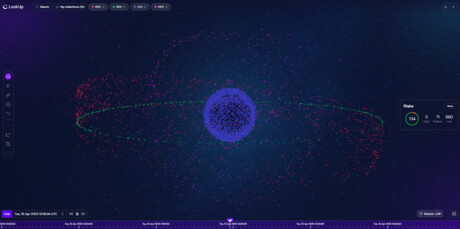
Look Up, a European company specialising in space situational awareness, has published the fourth edition of its Look Up x Le Point Space Barometer in partnership with weekly magazine Le Point. The Space Barometer aims to provide public decision-makers, industry, the media and the wider public with a regular, objective snapshot of the transformation emerging in space — with this latest edition highlighting an acceleration in orbital activity and an increasingly dense, dynamic and complex space environment.
Based on data collected and processed by Look Up’s SYNAPSE digital platform, the number of active satellites orbiting the Earth has risen from 13,005 last year to 16,819 this year — an increase of 29%. More than 34,000 objects are now tracked in Earth orbit, including satellites, rocket stages and catalogued space debris.
With 4737 satellites launched over the past 12 months, the deployment of new orbital infrastructure continues at an unprecedented pace, supporting telecommunications, Earth observation, navigation, defence and connectivity. But this increasing density is simultaneously creating growing challenges for space surveillance, safety, security, coordination and space traffic management.
Starlink remains the world’s largest satellite constellation, with 11,041 active satellites — up from 8267 a year ago (+34%) — and accounting for nearly two-thirds of all active satellites orbiting the Earth. Around 640 of these satellites are specifically dedicated to Starlink’s Direct to Cell service, operating at an altitude of approximately 360 km. This component of Starlink alone represents a fleet almost equivalent in size to the entire European Eutelsat OneWeb constellation, which currently comprises 651 active satellites. Starlink is also reorganising a significant part of its constellation towards lower orbits, further illustrating the constant evolution of the orbital environment.
China is also rapidly expanding its orbital capabilities, now operating 1434 active satellites compared with 1136 a year ago, representing a 26% increase. This growth is notably driven by the development of large low-Earth orbit constellations and is accompanied by increasingly advanced manoeuvring capabilities. The fourth flight of China’s experimental spaceplane provides a recent illustration: after releasing an object weighing approximately 500 kg, the vehicle conducted several proximity operations with it in orbit.
In-orbit manoeuvring capabilities are also evolving rapidly. In July 2026, US company True Anomaly conducted a pursuit-and-evasion exercise involving two satellites, Jackal-4 and Puma, with some approaches performed autonomously using onboard sensors. This illustrates how rendezvous and proximity-operation capabilities, previously mainly associated with state actors, are becoming increasingly accessible to commercial operators.
Meanwhile, 1412 objects have been deorbited over the past 12 months, including 914 satellites. Of these, 507 were Starlink satellites, reflecting the continuous renewal of the constellation. Finally, the Chinese Yaogan 50-02 satellite fragmented in late August, generating 42 new pieces of catalogued debris on orbits ranging from 600 to 1100 km.
Between launches, deorbiting, manoeuvres and fragmentation events, it is clear that the orbital population is evolving continuously.
“We are no longer simply facing an increase in the number of satellites, but a profound transformation of the orbital environment,” said Michel Friedling, co-founder and CEO of Look Up and former Commander of French Space Command. “Constellations are expanding, satellites are manoeuvring more frequently, and proximity operations are multiplying.
“In a space domain that has become strategic and contested, knowing precisely what is happening in orbit is now a prerequisite for sovereignty. For Europe, mastering space begins with mastering space domain awareness.”
ACCC seeking views on mobile coverage and services
The ACCC is seeking views from Australian consumers and businesses as it commences public...
Airbus–Broadtech MOU to explore next-gen comms for NZ
Comms Connect Melbourne saw Airbus Defence and Space sign an MOU with Broadtech to support New...
ICEYE and Nokia partner to launch sovereign satellite comms
ICEYE and Nokia will develop secure, sovereign and high-performance broadband LEO satellite...