Tiny satellite to eavesdrop on whispers from the early universe
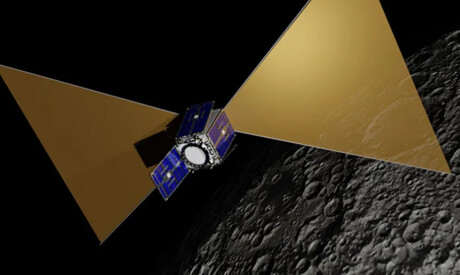
An international team of scientists, led by the University of Cambridge, is planning on using a tiny satellite to answer one of the biggest questions in cosmology: what happened in the roughly 150 million years of cosmic dark ages, before the universe’s first stars appeared?
The researchers will use the dark side of the Moon as a ‘shield’ so that the satellite — dubbed ‘CosmoCube’ and about the same size as a small carry-on suitcase — can block out all the noise from Earth and listen for a faint whisper from the very early universe. This whisper, known as the 21-centimetre line, is a signal emitted by hydrogen atoms in the period between the afterglow of the Big Bang and Cosmic Dawn, when nuclear fusion lit up the first stars.
No one has directly observed this era before, as detecting this signal from more than 13.5 billion years ago is extremely difficult with Earth-based telescopes. This is because the Earth’s ionosphere blocks the right frequencies, and interference from FM radio, satellites and telecommunications drowns it out. However, the Moon provides a natural shield.
As CosmoCube orbits the far side of the Moon, it will be shielded from all the noise of Earth for roughly 40 minutes of each two-hour orbit. Over an expected two-year mission, it will build up 1000 hours of data on one of the last unexplored periods of the universe, helping us understand how the universe transitioned from dark and nearly empty to the complexity we see today.
“This emission from hydrogen after the Big Bang, but before the first stars, will hopefully allow us to understand the role of dark matter in the early universe, how it worked to pull together hydrogen into the first stars and galaxies,” said lead author Professor Eloy de Lera Acedo, from Cambridge’s Cavendish Laboratory.
To study this period, CosmoCube will operate at extremely low frequencies — between 10 and 50 MHz — far outside the range of ground-based telescopes, which is why the Moon will be used as CosmoCube’s ‘fortress of solitude’.
“There’s no other place where you can get the sort of shielding you need to detect such a faint signal, while at the same time looking at the whole of space,” said de Lera Acedo, who is also affiliated with the Kavli Institute for Cosmology. “The far side of the Moon is really the only option: it solves multiple problems at once, opening a clear window to the very early universe.”
Once in orbit around the Moon, CosmoCube will unfold a long and lightweight radio antenna, sensitive enough to detect the 21-centimetre signal from hydrogen atoms in the early universe when the satellite is on the Moon’s far side. While in lunar orbit, the satellite will constantly check and correct its own electronics using a ‘Dicke-switched’ calibrator, which will flip between the sky and several built‑in reference sources. This will help cancel out tiny drifts and noise inside the satellite that could otherwise masquerade as cosmic signals.
Once CosmoCube’s data is back on Earth, the team will use advanced Bayesian statistical methods to remove foreground noise — mainly radio emissions from our own galaxy. They will also reconstruct how the antenna responds to different parts of the sky using computer simulations and in-flight measurements, allowing them to subtract any remaining distortions.
“Aside from the science, what makes our mission unique is its size: we’re probing the earliest, deepest parts of the dark ages that others don’t reach, but with a compact, relatively low-cost platform,” de Lera Acedo said.
Instrument development for CosmoCube is already well underway, with functioning lab prototypes and environmental testing now taking place. With the mission having received funding from the UK Space Agency, the researchers hope the satellite can be launched within the next five years — ideally before similar missions that are being planned by the US, India and other countries to take advantage of the Moon’s silence.
SA bolsters emergency radio network ahead of boating season
A $1m upgrade of SA's VHF radio repeater network is now complete, improving critical distress...
Teltronic to provide broadband comms for Chilean train lines
The broadband communications network will provide data transmission services for two new lines of...
MOU aims for laser link between re-entry vehicle and satellite
Astroligh and ATMOS Space Cargo aim to jointly demonstrate the first in-flight optical...