
Amplifier chip extends range for wake-up receivers
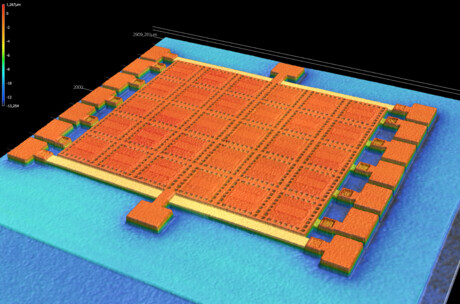
Researchers from the Fraunhofer Institute for Photonic Microsystems IPMS and the Hamburg University of Technology have created an amplifier chip that increases the sensitivity of wireless sensors without increasing their power consumption. The work was conducted as part of the MEMS-ParAmps project, which ran from 1 October 2021 to 16 January 2026.
Wake-up receivers keep sensor nodes in a constant state of readiness to receive signals without activating the main electronic circuitry. They require very little energy to do so; however, their reception sensitivity is significantly limited, which restricts the achievable radio range. Therefore, the project consortium adopted the approach of connecting a parametric MEMS amplifier in series with the receiver. The team defined target values of up to 10 years of battery life and a range of up to 1 km in open space.
“Until now, you had to choose between long range and long battery life,” said Dr Michael Stolz, Project Manager at Fraunhofer IPMS. “With our new amplifier chip, though, it’s possible to have both.”
The project covered the entire development process, from system specification to the design and fabrication of a micromechanically tuneable capacitor (MEMS varactor) and its associated drive circuit. A key focus was an energy-efficient voltage pulse generator that can excite the varactor mechanically with approximately 3.3 microjoules per pulse; this corresponds to a tiny fraction of the energy of an LED lamp. Since no commercial measurement systems met the requirements, the project partners also developed their own methodology for dynamic capacitance measurement with a bandwidth of over 10 MHz to verify the functionality of the component.
To ensure that the technology also works in practice, the team adapted an existing wireless communication protocol for large distances between sensors. Together with industry partner Actemium BEA, the subsystems were tested in a simulated laboratory scenario. The central communication platform, consisting of a low-power microcontroller and radio transceiver, was also built and successfully tested. This demonstrated the basic feasibility of the approach at the theoretical and simulation level.
“Adapting the protocol to large distances between nodes was just as important as the hardware itself,” said Prof Dr Alexander Kölpin, Project Manager at the Hamburg University of Technology.
“Validation in the laboratory scenario showed that the concept can be transferred to the conditions of industrial applications,” Kölpin continued. Indeed, the developed MEMS components and circuit concepts have a variety of applications, including low-noise mixers, highly sensitive wake-up receivers and self-powered sensor nodes.
Automating satellite back-up for submarine cable networks
The European Space Agency has funded a project to detect submarine cable interruptions and switch...
Acoustic sensing used for drone detection
Researchers have developed an intelligent acoustic sensor solution that detects and localises...
Savox Communications launches next-gen military comms system
Savox MissionCore is an open and interoperable mission platform designed to transform fragmented...